Behind Every Parkinson’s Researcher, There’s a Story
Stories, turning points, and motivations shaping the next generation of therapeutics for Parkinson’s disease.
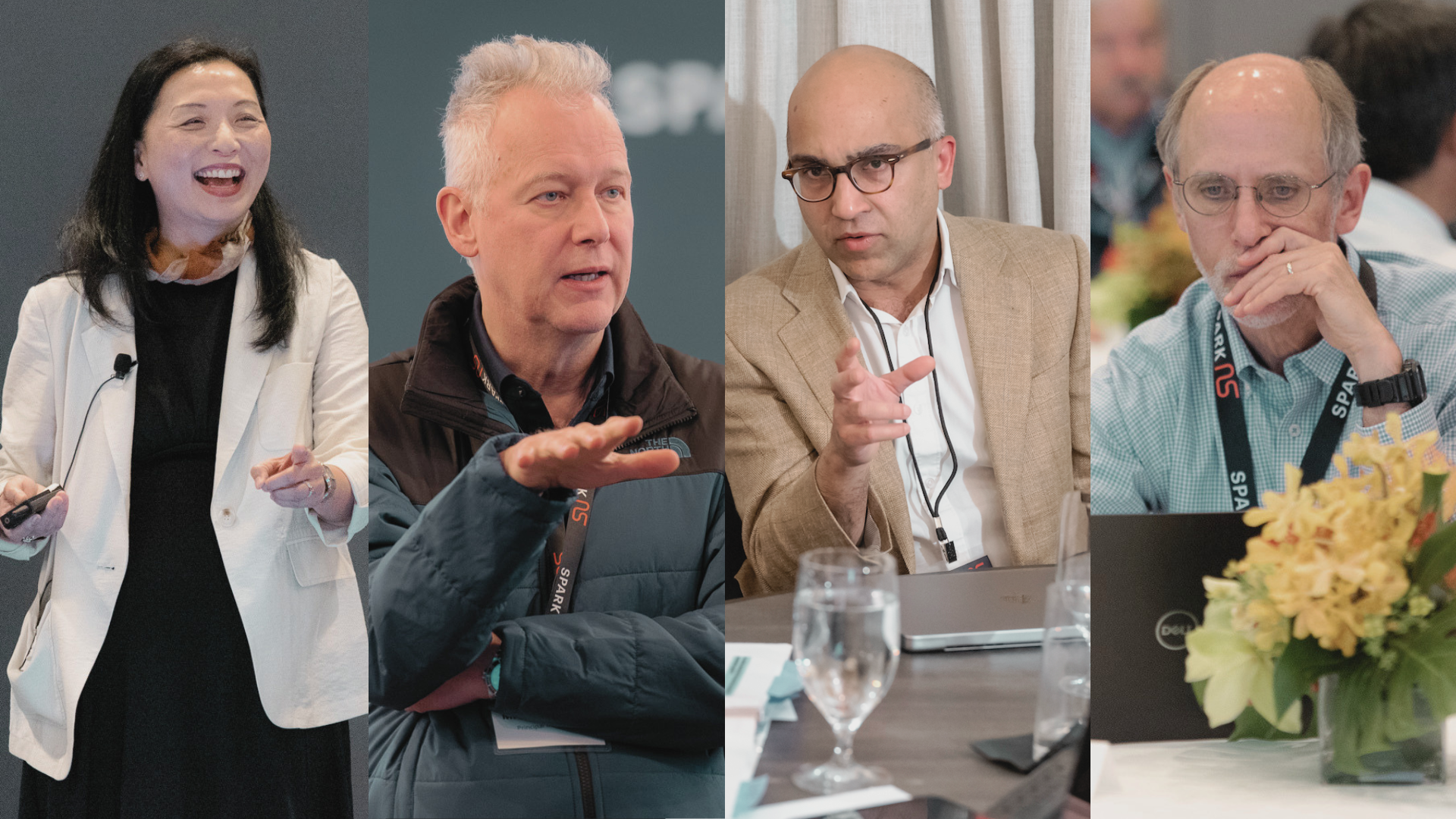
Parkinson’s disease affects more than 12 million people worldwide and is the fastest growing neurodegenerative disease, yet no therapeutics exist to slow or reverse its progression. Changing its course depends largely on the work of academic researchers dedicating their lives to understanding the disease and developing new treatments. As part of Parkinson’s Disease Awareness Month, we spoke with principal investigators in the SPARK NS Translational Research Program who are working to develop new therapeutics for Parkinson’s. Their comments reveal how they found their way into the field and what continues to drive their work forward.
Where It All Began
For some researchers, the path to Parkinson’s disease began far from the lab. “I am an accidental scientist,” said Alice S. Chen-Plotkin, MD, Parker Family Professor of Neurology, University of Pennsylvania, and a principal investigator in the SPARK NS 2024 Cohort. As an English major who wrote poetry, Dr. Chen-Plotkin’s parents influenced her decision to go to medical school and a class on the brain led her to neuroscience. “That class was totally captivating. I could see that there was another way to understand human behavior, one that was just as compelling as poetry.”
That experience led Dr. Chen-Plotkin to pursue a career as a neurologist-neuroscientist, one that would allow her to keep learning how the brain works across different levels, while also building close, meaningful relationships with patients. Nearly 20 years into her work, that motivation remains central: “I have loved having a career that spans the creativity of research, the practicality of managing real-world problems in the lab and in the clinic, and the satisfaction of being of service to others,” she said.
Miratul Muqit, MBChB, PhD, Professor of Experimental Neurology, University of Dundee, and a principal investigator in the SPARK NS 2025 Cohort, found his way into Parkinson’s research through an unexpected early influence. As a young medical student, he watched an episode of the BBC series Horizon that showed patients who developed Parkinson’s after being exposed to a toxin called MPTP. What he saw about the challenges these people face, and the lengths they were willing to go for treatment, piqued his curiosity. A subsequent research experience further solidified his path toward becoming a neurologist and researcher.
For David K. Simon, MD, PhD, Professor of Neurology, Beth Israel Deaconess Medical Center and Harvard Medical School, and a principal investigator in the SPARK NS 2025 Cohort, his dedication began with a scientific interest in how neurons survive and form connections paired with a clinical fascination with Parkinson’s patients and the ability to make a tangible difference in their lives. Over time, that interest deepened, even as Parkinson’s became part of his own family’s story. “ My father and his mother both had Parkinson’s,” said Dr. Simon.
Michael Johnson, DPhil, FRACP, FRCP, Professor of Neurology and Genomic Medicine in the Department of Brain Sciences at Imperial College London, and a principal investigator in the SPARK NS 2026 Cohort, followed a journey shaped by both clinical experience and opportunity. “I'm a clinical neurologist and I've looked after lots of patients with Parkinson's disease so I've had extensive experience with the condition,” said Dr. Johnson. That interest evolved into active drug discovery and development when a pharmaceutical company approached him to collaborate on a drug target discovery project.
The Moment Research Became Real
When PIs were asked to recall a moment their work began to feel real—when they realized it could truly impact patients and their families—the answers varied. For some, that realization came gradually.
As both a clinician and scientist, Dr. Muqit, recalls being asked by patients whether his research would directly help them. It was not a question always easy to answer early in his career. As his work on the PINK1 pathway and mitophagy progressed, and as the broader field advanced, the connection became clearer. “It was through a series of discoveries—from my lab and others in the field—that I realized this knowledge could be used to develop new drugs,” he said. “It was amazing to see two drugs enter Phase 1 clinical trials for Parkinson’s patients in 2024.”
For others, the moment was more immediate. Dr. Johnson describes a turning point rooted in data, when a compelling genetic signal revealed a missed opportunity in the field. “I was looking at our results for Parkinson’s disease, and I thought ‘why hasn’t this target been developed when the genetic evidence for causality is so compelling?’” That insight, which Dr. Johnson describes as a “lightbulb moment,” helped shape a new direction in his work focused on improving how drug targets are identified and validated.
For Dr. Chen-Plotkin, the moment came through a scientific discovery. Identifying a gene linked to disease progression, and recognizing it as a viable therapeutic target, shifted her perspective on what might be possible. “What I liked about GPNMB as a target is that it is tied to cell-to-cell spread of alpha-synuclein pathology, which likely occurs throughout the disease, not just at the earliest stages,” she said. “It's always been clear to me that people are only very mildly affected when they are diagnosed. If we could stop the disease from progressing from that point, then PD would be a mild condition.”
For Dr. Simon, the connection between research and impact has been reinforced over time through clinical experience. “Every time I see a patient progressing, this is what strongly motivates me to work in the lab to try to find ways to slow or stop progression of the illness,” he said. He also pointed to moments in his research that strengthened that sense of possibility, particularly when early findings suggested a potential path toward disease-modifying therapies. He said, ”I am grateful to SPARK NS for giving us the guidance and support we need to take the next key steps.”
Where Optimism Comes From
Progress in Parkinson’s research has not been linear, but optimism remains strong, not in spite of past setbacks, but because of what has been learned from them.
Dr. Chen-Plotkin reflected on how quickly the field has evolved. Over the past two decades, researchers have moved from limited understanding to identifying key molecular players such as alpha-synuclein, LRRK2, and GBA1, as well as developing models to study disease progression. This transformation, she noted, mirrors advances seen in other areas of medicine, such as cancer, where molecular insights have led to meaningful therapeutic progress.
Dr. Simon shared a similar perspective, emphasizing how much the field has gained from past challenges. “One could get discouraged from the many failed clinical trials for disease modification in Parkinson’s. In this context, I love the Nelson Mandela quote, ‘I never lose. I either win or I learn’,” he said. “We have learned a lot from prior lab research and clinical trials… as a result, the newer potential therapies being developed are much more likely to succeed.”
For Dr. Muqit, optimism is based on the growing number of critical mechanisms that are well validated and independently replicated—a process, he noted, that is likely to be accelerated with the emergence of AI-based approaches.
Dr. Johnson captured the current moment succinctly: “We are no longer dependent on small molecules, so previously undruggable targets can now be drugged,” he said. “This is an age of rapid pharmacological innovation.”
The Legacy They Hope to Leave Behind
This sense of progress shapes not only how academic researchers in the SPARK NS program view the present, but also how they think about the future and the impact they hope to leave behind. When asked what they would like people to remember about their work, the answers reflect both ambition and humility.
For Dr. Chen-Plotkin, the goal is clear: her work is deeply rooted in patient needs. By focusing on human data and identifying the biological drivers of real-world disability, her aim is to develop therapeutics that address what matters most to people living with Parkinson’s.
A similar sense of purpose guides Dr. Muqit. “Whilst fundamental in nature, our research was primarily driven to improve the lives of patients with Parkinson’s, and we never lost sight of that goal,” he said.
For Dr. Johnson, the work is grounded less in legacy and more in responsibility. “For me, working to advance science and hopefully treatments for people with Parkinson’s is a huge honour and a profound responsibility,” he said. “We are determined to do our best for the community.”
Dr. Simon’s answer was straightforward: “I hope they remember that ‘his work cured Parkinson’s!’”
Advancing the Work. Together.
From the paths that led these researchers into Parkinson’s disease, to the impact they hope to leave behind, one theme runs throughout: advancing new treatments is as much human as it is scientific—and depends on the right support to move ideas forward. At SPARK NS, that support takes shape through a translational research model that stresses science and collaboration with industry experts and other researchers.
Learn more
- Explore the projects and principal investigators currently in the SPARK NS Program
- Learn more about the SPARK NS Translational Research Program and how to apply for the 2027 Cohort on the “Call for Proposals” page of the SPARK NS website
- Sign up for updates on the 2027 Cohort of the program and other SPARK NS news